A $400 portable projector advertised as “4K” almost never produces a native 4K image. It accepts a 4K signal, downscales it, and throws out a picture that’s often closer to 720p or 1080p in actual resolved detail. We’ve lost count of how many readers have written in confused about why their new projector looks soft against the lounge room wall despite the box promising cinema-grade clarity. This is the single biggest gap between what portable projectors are marketed as and what they actually deliver, and it’s worth sorting out before you spend anything.
Portable projectors are genuinely useful. A backyard movie night, a tradie showing a client renders off a laptop, a share house without a telly, a camping trip with a sheet strung between two trees. We’re just not convinced they’re the TV replacement a lot of the spruiking suggests, and that’s the mildly unpopular view we’ll defend here: for most Australian loungerooms, a decent telly still beats a portable projector on nearly every measure except portability itself.
Brightness is the number that actually matters
Forget resolution for a moment. The spec that decides whether your picture looks washed out or watchable is brightness, usually listed in ANSI lumens. Cheaper projectors often quote “lumens” without the ANSI qualifier, which is a looser, more generous measurement that makes a weaker light source sound stronger than it is. If a listing doesn’t say ANSI, assume the real-world brightness is meaningfully lower than the number implies.
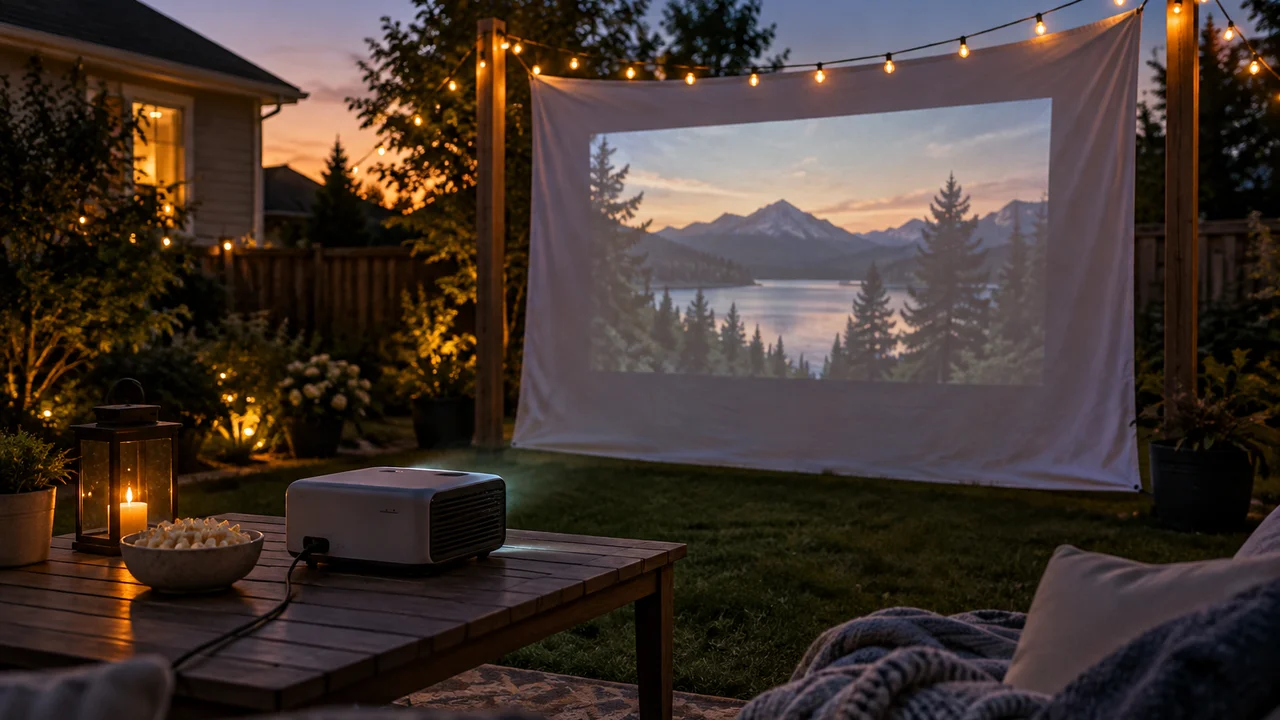
In practice, anything under around 300 ANSI lumens needs a properly dark room to look good. That rules out most Australian lounge rooms during daylight hours, and it rules out almost any outdoor use before full dark. If you want to watch something at dusk on the back deck, you’re looking at projectors well north of that, and the price climbs accordingly. We’d rather a reader buy a dimmer projector knowing exactly when they’ll use it than a bright one they end up disappointed by because nobody explained the lumens figure properly.
Battery life is where the marketing gets vague
Built-in battery is the headline feature on most portable projectors, the thing that separates them from a plug-in home theatre box. But “up to 3 hours” on the box rarely accounts for brightness mode, volume, or whether you’re running a streaming app directly on the device versus casting from a phone, which draws extra power on both ends. Our experience is that real playback time, at a brightness you’d actually want to watch, tends to land noticeably under the advertised ceiling.
If a projector is going camping or to the cricket nets for a post-game review session, we’d treat the quoted battery figure as a best-case scenario and plan around half of it. A portable power bank with enough output to top up the projector mid-film is a sensible accessory, not an optional extra, and it’s the same logic we’ve applied when writing about smartphone battery life tips: manufacturer numbers are measured under ideal lab conditions that rarely match how people actually use the thing.
Autofocus and keystone correction aren’t always automatic
A lot of current portable projectors advertise autofocus and auto keystone correction, meaning the image squares itself up and sharpens without you fiddling with manual dials. When it works, it’s genuinely handy. When it doesn’t, and we’ve seen this often enough to flag it, the autofocus hunts for several seconds every time you nudge the projector, or the keystone correction crops into the image enough that you lose picture area you paid for.
Surface matters more than people expect too. A painted wall, a bedsheet, a proper projector screen and a roller door all behave differently, and colour accuracy suffers on anything that isn’t a flat, neutral white. If you’re projecting onto a wall painted anything other than white or very light grey, expect the colours to shift, sometimes substantially.
Noise and heat are the rough edges nobody photographs
Projectors run a bulb or LED light engine and a cooling fan, and the smaller and more “portable” the unit, the harder that fan usually has to work in a tighter chassis. We’ve used portable projectors that are genuinely distracting in a quiet room, fan noise sitting somewhere between a laptop under load and a small desk fan. For casual outdoor viewing with background chatter this doesn’t matter. For a quiet indoor movie night it absolutely does, and it’s not something spec sheets mention because there’s no agreed consumer metric for it the way there is for lumens or battery capacity.
Heat is the other side of that coin. Leave a projector running in direct sun or inside a hot car, which happens more than people admit in an Australian summer, and thermal throttling can dim the image or shut the unit down to protect the battery and light source.
Connectivity decides whether it’s actually convenient
Most mid-range portable projectors now run some version of Android or a custom smart TV interface with Netflix, YouTube and a browser built in. The catch is software support. Cheaper projector brands update their firmware rarely, if at all, and we’ve seen units stuck on outdated app versions within a year or two of release, with no clear path to fix it. That’s a repairability and longevity issue just as much as a cracked screen is, and it’s the same reason we keep telling readers to check update commitments on tablets before buying one, not just the spec sheet on day one.
HDMI input is still the most reliable way to get a clean picture, particularly from a laptop, games console or set-top box. Wireless casting from a phone works, but screen mirroring over Wi-Fi introduces lag that’s fine for a film and genuinely annoying for anything interactive, including games or a video call thrown up on the big screen for a family overseas.
What to check before buying
- ANSI lumens figure, not just “lumens”, and whether it suits daylight, dusk or full dark use
- Realistic battery runtime at a usable brightness, not the box’s best-case number
- Whether the manufacturer has a track record of firmware and app updates for this model line
Who actually gets good value from one
Students in share houses without a telly get a lot out of a mid-range portable projector, especially one with a reasonable built-in speaker, because it solves a real problem cheaply compared to buying a television outright. Parents wanting an easy outdoor movie night for a kid’s birthday are another good fit, provided expectations are set around dusk timing and lumens. Tradies and small business owners showing plans, renders or quotes to a client on site benefit from the portability angle specifically, where picture perfection matters less than simply having a big, legible image available anywhere.
Where we get more sceptical is the person replacing their main television with a projector to save money or space. Ambient light control, noise, heat and the ongoing software support gap mean a projector asks for more compromise day to day than a modern TV does, and a $600 projector that falls out of update support in eighteen months is a harder loss to swallow than most people expect going in.
Pricing bands worth knowing
At the time of writing, budget portable projectors sit roughly in the $150 to $350 range and are best treated as a fun occasional-use device rather than a primary screen. The $400 to $800 band tends to bring meaningfully better brightness, built-in battery and smart platform support, and is where most households land if they’re serious about the category. Beyond that, you’re generally paying for laser light sources, properly bright output suitable for daylight use, and better optics, and at that point it’s worth asking honestly whether a mounted short-throw unit or simply a larger television serves the room better.
Consumer guarantees under Australian Consumer Law apply to projectors the same as any other electronics purchase, meaning a unit that fails to do what it was advertised to do, like hitting a stated brightness or battery figure under normal use, may be grounds for a remedy regardless of what the retailer’s own returns policy says. The ACCC’s guidance on repair, replace and refund rights is worth a read before you argue with a customer service desk about a dim, laggy unit. If you’re buying online from overseas, the Product Safety Australia recall and safety database is also worth a quick check, since cheap imported electronics are a recurring category in recall notices.
Our verdict on portable projectors
We reckon portable projectors are at their best as a second screen for a specific job, camping, backyard nights, work presentations away from the office, rather than a lounge room centrepiece. The category has genuinely improved on battery life and smart features in the last couple of years, but the gap between the marketing lumens figure and what you’ll see in a half-lit room hasn’t closed much, and that’s the thing we’d want every reader to understand before they order one.
If you’re buying for a specific occasion, work out the brightness you need for that occasion first, then budget for the battery buffer and a decent HDMI cable, and treat the smart platform as a bonus rather than the main reason to buy. Same logic we’d apply to any connected gadget around the house, including the broader home network it all has to talk to, which is also why we keep an eye on things like WiFi 7 home network changes when we’re assessing how well a projector’s wireless casting will actually perform in a typical Australian house with a few walls between the router and the back deck.
— Priya Raman, Reviews Editor, Tech Geek
Featured image: AI-generated illustration.