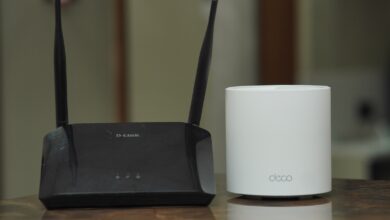
WiFi 7 routers have started turning up on Australian shelves over the past year, usually with a price tag that makes you pause and a marketing sheet full of numbers that don’t mean much on their own. Multi-gigabit, ultra-low latency, “the fastest WiFi ever” — we’ve heard versions of this pitch with every generation. So we sat down and worked out what WiFi 7 genuinely changes for a typical Australian home, what it costs to get there, and — the bit most reviews skip — whether your internet plan is even fast enough to make any of it noticeable.
What WiFi 7 actually is
WiFi 7 is the marketing name for the IEEE 802.11be standard, and it brings three changes that matter in practice rather than just on a spec sheet.
- Wider channels — up to 320MHz on the 6GHz band, double the 160MHz ceiling of WiFi 6E, which is what actually lets a single device push multi-gigabit speeds over WiFi.
- Multi-Link Operation (MLO) — the headline feature. A WiFi 7 device can talk to the router over more than one band at once (say, 5GHz and 6GHz simultaneously), splitting traffic across both to cut latency and avoid congestion when a band gets busy.
- 4K-QAM modulation — a denser way of encoding data into the radio signal, which lifts theoretical throughput even when channel width is unchanged.
The standard is managed globally and the spectrum it depends on is regulated locally, which is where the Australian Communications and Media Authority comes in. The ACMA is responsible for allocating and licensing the 6GHz band here, and Australia has followed most of the rest of the world in opening a slice of that spectrum for WiFi use — which is what makes WiFi 6E and WiFi 7’s wider channels legally usable in Australian homes at all. Without that regulatory work, the hardware could ship but the extra spectrum simply wouldn’t be available to use.
WiFi 7 versus WiFi 6 and 6E
It helps to see the three generations side by side rather than in isolation:
- WiFi 6 (802.11ax) — introduced OFDMA and better handling of many connected devices, but capped at 160MHz channels on 5GHz and no access to 6GHz spectrum.
- WiFi 6E — same core standard as WiFi 6, but adds access to the 6GHz band, which is far less congested than 2.4GHz and 5GHz because almost nothing else uses it yet.
- WiFi 7 (802.11be) — builds on 6E’s 6GHz access, doubles maximum channel width to 320MHz, adds Multi-Link Operation, and uses denser modulation for higher peak throughput.
In real terms, the jump from WiFi 6 to 6E was mostly about congestion — moving newer devices onto a clean, uncrowded band. The jump from 6E to WiFi 7 is about raw capacity and consistency: wider pipes, and MLO smoothing over the moments when one band is busy or noisy. For most households, the latency improvement from MLO is more noticeable day to day than the peak-speed numbers, particularly for video calls and competitive online gaming, where a stable low-latency link matters more than an occasional multi-gigabit burst nobody’s connection can actually use.
Which routers support it in Australia, and what they cost
WiFi 7 hardware is available here now, not just announced. As of mid-2026, the local lineup roughly breaks down like this:
- Entry-level WiFi 7 mesh systems (TP-Link Deco BE and Archer BE series, some Netgear Nighthawk models) — typically $400 to $700 for a single unit or small two-pack, positioned as the practical starting point for most homes.
- Mid-range single routers (Asus RT-BE and TUF-AX/BE ranges) — usually $500 to $900, aimed at gamers and households with a lot of connected devices.
- Flagship and multi-node mesh systems (Asus ZenWiFi BE, Netgear Orbi 970 series, TP-Link Deco BE95) — commonly $1,200 to $2,500-plus for a full-house kit, aimed at large homes or people who want every gigabit their connection offers.
Availability is solid through the major retailers and ISPs are increasingly bundling WiFi 7 modems with their higher NBN tiers, but it’s still a premium category — you’re paying roughly 30–50% more than an equivalent WiFi 6E model for the same footprint. That premium is worth keeping in mind before you upgrade, especially if the rest of your setup (the modem, your devices, your plan) can’t yet take advantage of what you’re paying for.
Does your NBN plan even matter?
This is the part most buying guides gloss over, and it’s the one that decides whether any of this is worth it for you. WiFi 7’s headline speeds are about what a router can move between devices on your own network — they have nothing to do with how fast your internet connection is. If you’re on an NBN 50 or NBN 100 plan, the fastest new router in the world still can’t make your internet faster than your plan allows; the bottleneck is the connection into your home, not the WiFi hop from router to device.
Where WiFi 7 genuinely pays off is on two fronts. First, higher-tier plans — NBN 500, NBN 1000 (Home Ultrafast), or Opticomm/HFC equivalents — where a WiFi 6 or 6E router can actually struggle to deliver the full plan speed to a single device wirelessly, and WiFi 7’s wider channels close that gap. Second, and arguably more relevant for most households, local network traffic that never touches the internet at all: transferring large files between a laptop and a NAS, streaming from a media server to a smart TV, or backing up phones to a home server. That traffic runs entirely over WiFi and benefits from every bit of extra local bandwidth and lower latency, regardless of what NBN plan you’re paying for.
If your household mostly does web browsing, streaming and video calls on a mid-tier NBN plan, you almost certainly won’t notice a difference upgrading to WiFi 7 today. If you’re on a top-tier plan, run a home server or NAS, or have a house full of 4K streaming devices and gaming consoles competing for bandwidth at once, that’s where the standard starts to earn its price tag.
Who should upgrade now versus wait
Our take, after going through the specs and the pricing, comes down to a few practical scenarios:
- Upgrade now if you’re on NBN 500 or above and currently can’t get close to that speed on WiFi, if you run a home NAS or media server, or if you’ve got ten-plus devices fighting for bandwidth at peak times.
- Wait if you’re on NBN 50 or 100, your current router handles your household fine, and you don’t have a specific bottleneck you’re trying to solve. Prices will keep falling and device support (phones, laptops) is still catching up — most flagship phones only added WiFi 7 chipsets in the last generation or two.
- Consider WiFi 6E instead if you want the 6GHz band’s reduced congestion without paying the WiFi 7 premium — a genuinely solid middle ground right now, especially since few home devices can fully exploit MLO or 320MHz channels yet anyway.
It’s also worth thinking about this the same way you’d think about any other technology purchase for the house: match the spend to an actual problem you have, not to the newest number on the box. We see the same pattern with mobile networks — our breakdown of 5G coverage and speeds across Australia makes a similar point, that the theoretical peak numbers carriers advertise rarely reflect what you’ll get on an average day, and the smarter move is usually to buy for the connection you actually have rather than the one in the brochure.
If you run a business from home and your website’s load times or checkout speed matter to your income, it’s worth separating two different problems here. A faster local network helps you personally — uploading files, video calls, remote desktop sessions — but it does nothing for how fast your website loads for customers, which comes down to hosting and front-end performance instead. We’ve covered that separately in our guide to effective website optimisation for more sales, and it’s a better first stop than a router upgrade if conversions are the actual goal.
One thing that doesn’t change with any WiFi generation is basic network hygiene. A shiny new WiFi 7 router is still only as secure as its configuration — change the default admin password, keep firmware updated, and use WPA3 rather than leaving WPA2 compatibility mode switched on for older devices unless you actually need it. The Australian Cyber Security Centre publishes clear, regularly updated guidance on securing home networks and routers, and it’s worth a read regardless of which generation of hardware you’re running. The same discipline applies if you manage a website rather than just a home network; we’ve written before about how to protect your website from data breaches, and a lot of the underlying advice — strong credentials, timely updates, limiting who has access — carries across from routers to servers to CMS logins without much translation needed.
Final thoughts
WiFi 7 is a real, meaningful step up rather than a marketing repaint of WiFi 6E — wider channels, Multi-Link Operation and denser modulation add up to a genuinely faster and more consistent local network. But “faster local network” and “faster internet” are two different things, and for a lot of Australian households on mid-tier NBN plans, the internet connection itself is still the limiting factor, not the WiFi standard delivering it around the house. If you’re on a high-speed plan, run local services like a NAS or media server, or have a busy household of competing devices, the upgrade is worth the premium today. If not, WiFi 6E remains a smart, cheaper middle ground, and waiting a generation for prices to settle costs you very little in practice.