Walk into any big-box electronics aisle in Australia and you’ll see gaming headsets ranging from about $40 to well over $500, often sitting side by side with near-identical black-and-red colour schemes. The spec sheets promise “50mm neodymium drivers” and “virtual 7.1 surround sound” like these are the things that will make you a better player. Mostly, they aren’t. Our take, after years of swapping headsets between PC, PlayStation and Xbox: the gap between a $60 headset and a $300 one is real, but it’s not where the marketing says it is.
This is one of those categories where the physics gets bent a bit by branding. A driver size tells you almost nothing about how something sounds. Two headsets with the same 50mm driver can sound completely different depending on tuning, the shape of the ear cup, and how well the headset seals against your head. So let’s get into what’s genuinely worth your money, and what’s there to make a $70 headset look like it belongs next to a $250 one on the shelf.
The surround sound myth that won’t die
“Virtual 7.1 surround sound” is printed on more gaming headset boxes in this country than almost any other phrase, and it’s mostly doing a job for the marketing department rather than your ears. Here’s the thing: a gaming headset has two drivers, one per ear. There is no physical way to generate genuine discrete surround channels from two speakers. What you’re getting is a software trick, usually a type of audio processing called HRTF (head-related transfer function), which tries to fool your brain into perceiving direction and distance.
Done well, this genuinely helps. Being able to tell that footsteps are coming from behind and slightly to your left, rather than just “somewhere”, matters in a tactical shooter. Done badly, it smears the sound, hollows out the mid-range and actually makes it harder to place enemies precisely. We’d argue that a genuinely well-tuned stereo headset with a clean, accurate frequency response will often let you pinpoint footsteps better than a mediocre virtual surround implementation layered on cheap drivers. The processing isn’t the problem. Cheap hardware wearing a surround sound sticker is the problem.
If competitive shooters are your main game, we’d rather you spent money on headset comfort and driver quality first, then worried about whether the software does Dolby Atmos for Headphones, DTS Headphone:X or a manufacturer’s own flavour. All three can be good. None of them fix bad drivers.
Wired versus wireless and the latency question
This is where frame rate arguments actually belong, because audio latency is a real, measurable thing and it does affect how a game feels, even if nobody puts a number on the box.
Bluetooth headsets, the kind you might already own for your phone, are generally a poor fit for gaming. Bluetooth audio codecs were built to save battery and bandwidth, not to minimise delay, and the resulting lag between an on-screen explosion and the sound reaching your ears is noticeable once you’re paying attention, even if it’s only tens of milliseconds. It’s the audio equivalent of input lag on a cheap TV: fine for a movie, annoying the moment timing matters. The Bluetooth SIG’s own technical overview explains why the standard prioritises power efficiency over latency, which is exactly the trade-off that trips gamers up.
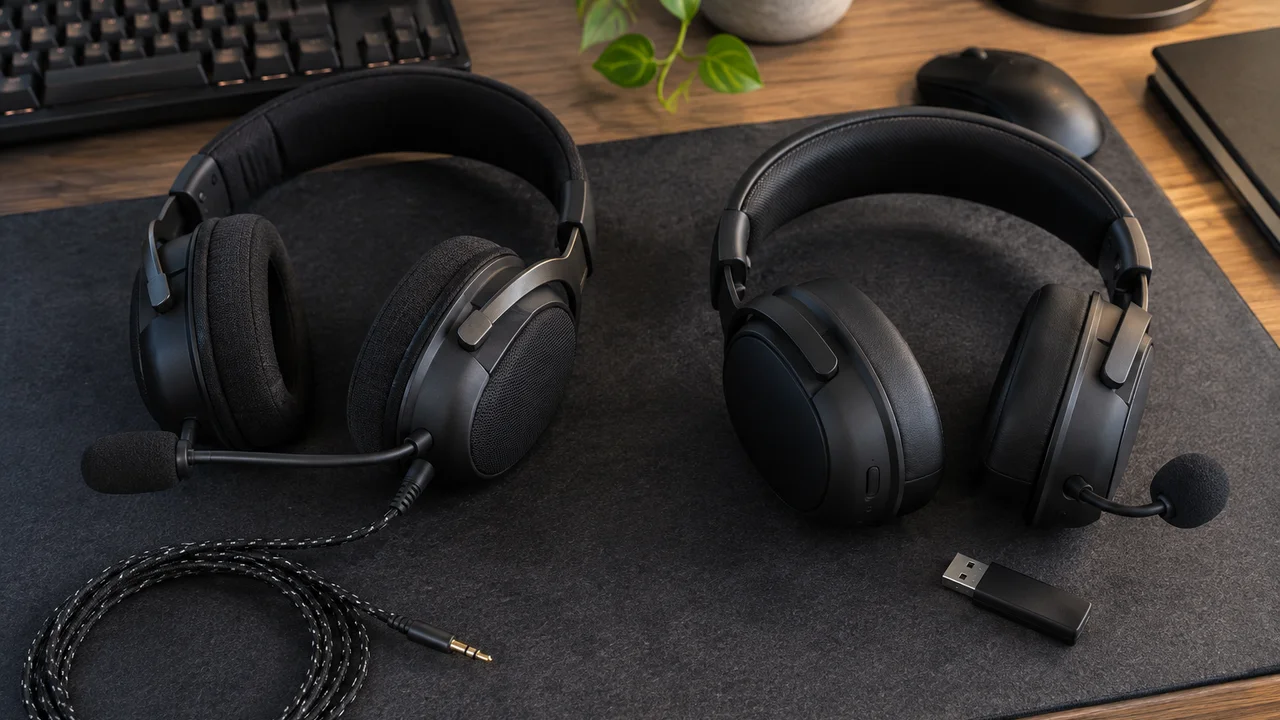
Proper gaming wireless headsets avoid this by using a dedicated 2.4GHz USB dongle rather than Bluetooth, which keeps latency low enough that most players won’t notice a difference from wired. That’s the feature actually worth paying for in a wireless headset: not the “wireless” claim itself, but whether it uses a low-latency dongle connection. If a headset only does Bluetooth and calls itself a gaming headset, be a little sceptical.
Wired still wins on raw reliability and, usually, value. There’s no battery to charge, no dongle to lose, and you’re typically paying for drivers and comfort rather than radios and batteries. If budget is tight, a good wired headset around the $80 to $120 mark will usually out-perform a wireless one at the same price.
The microphone nobody actually tests before buying
We reckon the microphone is the most underrated spec on the entire box, and it’s the one buyers check last, if at all. You’ll hear your own audio quality never; your squad, your raid group or whoever you’re yelling at in Rocket League hears it constantly. A tinny, hissy microphone makes you the person everyone mutes.
Look for a detachable or flip-to-mute boom microphone with some kind of noise gating or at least a cardioid pickup pattern, meaning it mostly picks up sound from directly in front of it rather than the rest of the room. Built-in microphones on the ear cup itself, common on cheaper and more fashion-led headsets, are almost always worse than a boom mic positioned near your mouth. If your household has a barking dog, a loud aircon or housemates, this matters more than any surround sound claim ever will.
Comfort is the real performance spec
Nobody puts clamping force on a spec sheet, but it’s the single thing that determines whether you’re still happily playing in hour three of a session or you’ve ripped the headset off in frustration because your head is throbbing.
A few things worth checking before you buy, ideally in person rather than from a box photo online:
- Memory foam ear cups with breathable fabric or protein leather tend to run cooler over long sessions than pure pleather, which traps heat.
- Weight matters more than most buyers expect; anything over roughly 350 to 400 grams starts to feel noticeable after an hour or two.
- A headband that distributes pressure across a wider area, rather than a thin strip digging into the top of your skull, makes a bigger difference than most people assume until they’ve tried both.
If you wear glasses, this becomes even more important. Ear cups that clamp hard against the arms of your glasses will give you a headache faster than any boss fight will. Some brands design cups specifically with glasses-wearer comfort in mind; it’s worth asking in-store or checking community feedback before committing.
What the price tiers actually buy you in Australia
At the time of writing, budget headsets in the $40 to $80 range from brands sold through Australian electronics retailers typically get you acceptable but unremarkable sound, a usable but basic microphone, and build quality that may not survive a few years of daily use. Fine for casual play, not something we’d recommend for someone gaming most nights.
The sweet spot, in our view, sits around $120 to $220. In this band you start seeing genuinely good drivers, detachable or better-quality microphones, properly cushioned ear cups and, on the wireless side, reliable 2.4GHz connections with reasonable battery life. This is where most Australians buying a headset for serious use should be looking.
Above $250, you’re generally paying for diminishing audio returns and increasing comfort, build quality and software ecosystem features, things like companion apps with EQ presets, swappable parts, and premium materials. Worth it if you game for hours daily and have the budget; not something we’d call essential. If you’re weighing up a headset purchase against a broader hardware refresh, our breakdown of current desktop CPU options is a useful companion read for anyone budgeting a whole new rig rather than one peripheral.
Is a headset even the right call, or should you go separate?
Here’s our mildly contrarian take: a lot of people buying a $200-plus gaming headset would get better results splitting that budget between a cheaper gaming headset or open-back headphones and a separate USB microphone. Headset microphones, even good ones, are compromised by having to sit on a boom arm attached to something also trying to be comfortable on your head. A dedicated desk microphone, even an entry-level one, will usually sound clearer to your teammates than anything built into a headset costing twice as much.
This only makes sense if you’ve got desk space and don’t need to move around while gaming, and it’s a bigger upfront outlay in pieces rather than one box. But for streamers, podcasters-on-the-side, or anyone who spends serious time on voice chat, we think it’s the better long-term setup. It’s a bit like choosing to build a gaming PC from parts rather than buying prebuilt: more fiddly upfront, better outcome for people who know what they want.
Console-specific quirks worth knowing before you buy
PlayStation, Xbox and Nintendo each have their own wrinkles. Sony’s PlayStation consoles support their own wireless audio formats via USB dongles that won’t necessarily work the same way, or at all, when you plug that headset into a PC later; check compatibility both ways if you split time between console and PC gaming, which is increasingly common given how good cloud gaming services have become at letting you jump platforms.
Xbox has its own proprietary wireless protocol for headsets, which is excellent when it works but limits your choice of wireless headsets to models specifically built for it, or ones using a 3.5mm cable through the controller. Nintendo Switch and Switch 2 are generally the pickiest, often favouring simple wired 3.5mm connections over proprietary wireless unless a headset explicitly advertises Switch support.
If you’re a multi-platform household, and plenty of Australian gaming setups are, a headset with a standard 3.5mm jack as a fallback option alongside USB or wireless gives you the most flexibility. It’s the boring, unglamorous feature, and it’s usually the one that saves you from buying a second headset six months later. And if you’re assembling a full PC gaming setup rather than buying piecemeal, our guide to current laptop chip options covers the other side of that budgeting equation for anyone going portable.
Our verdict on which gaming headsets to actually buy
If we were kitting out a mate who asked us straight up what headset to buy this week, we’d steer them towards something in that $120 to $220 range, wired if budget is the priority, low-latency wireless with a 2.4GHz dongle if convenience matters more. We’d tell them to ignore the surround sound sticker on the box and instead ask about the microphone, because that’s the part that actually affects other people’s experience of playing with them. The ACCC’s consumer guarantee rules also mean any headset sold here has to be fit for purpose regardless of what the marketing claims, which is worth remembering if a “gaming grade” unit falls apart within its first year.
And we’d gently suggest that if they’re mainly chasing better teammate communication rather than better game audio, a cheaper headset plus a basic USB microphone will beat a flagship all-in-one most days of the week. That’s not a popular opinion among headset marketing departments, but it’s the one we keep coming back to after enough sessions, across enough platforms, to trust it.
Whatever you land on, try to test it, or at least read genuine comfort feedback, before committing. The best headset on paper is the worst purchase if it gives you a headache by the second match. For readers building out a broader setup, our guide on wireless earbuds in Australia is worth a look if the headset is just one piece of a bigger audio upgrade.
— Josh Tannenbaum, Gaming Writer, Tech Geek
Featured image: AI-generated illustration.