Every year the “budget laptop” conversation gets a bit more confusing, not less. Specs that used to signal a genuinely cheap machine — 8GB of RAM, a spinning hard drive, a washed-out screen — are still floating around at prices that sound reasonable, while genuinely good value has crept into places most shoppers don’t think to look. In Australia in 2026, roughly $1,200 buys a laptop that will comfortably outlast a $1,200 machine from five years ago, provided you know which specs are worth paying for and which are just there to pad out a spec sheet on a shelf sticker.
We get asked some version of “what laptop should I buy” more than almost any other question at Tech Geek, and the honest answer is always the same: it depends on where you’re willing to compromise. A budget laptop is, by definition, a series of trade-offs. The trick is making sure the trade-offs land on things you won’t notice day to day, and not on the handful of components that quietly determine whether the machine feels fast in year one and still feels fast in year three.
What actually matters versus marketing fluff
Retail spec sheets are written to be skimmed, not understood, and budget laptops are where this shows up the most. A “2.6 million pixel display” sounds impressive until you realise that’s just a 1080p panel. “AI-ready” has become a sticker slapped on almost anything with a modern chip inside it, regardless of whether that chip has a neural processing unit worth mentioning. Even core counts can mislead — a chip with twelve small efficiency cores isn’t automatically faster than one with six well-balanced cores, and the way that chip is cooled inside a cheap chassis matters just as much as the number stamped on the box.
The specs that genuinely predict how a laptop will feel in daily use are narrower than the marketing suggests:
- The amount and type of RAM (and whether it’s soldered or upgradeable)
- Whether storage is a solid-state drive (SSD) or, rarely still, a mechanical hard drive
- Real-world battery life, not the “up to” number on the box
- The processor family and generation, not just the core count
- Build quality around the hinge and keyboard deck, since that’s where budget laptops fail first
Everything else — the exact screen resolution beyond 1080p, the number of USB ports, the brand of the trackpad — is far more negotiable than the average shopper assumes. If you’re trying to work out which chip platform actually suits your workload, our deep dive on how Lunar Lake, Apple’s M4 and Snapdragon X Elite compare is worth reading before you commit, because the processor family underneath a budget laptop’s branding often matters more than the model name on the lid.
Where you can safely cut corners
Budget laptops have to save money somewhere, and there are several places where that saving genuinely doesn’t cost you much in daily use.
Screen quality is the biggest one. A cheaper laptop will almost always have a TN or lower-grade IPS panel with narrower colour reproduction and dimmer maximum brightness than a premium model. For everyday browsing, email, streaming and document work, this is a compromise most people stop noticing within a week. It only becomes a real problem if you’re doing colour-sensitive photo editing or spend a lot of time working outdoors in direct sunlight, where a dim, low-contrast panel genuinely struggles.
Build materials are the second safe corner. Budget laptops lean on plastic chassis rather than aluminium or magnesium alloy, and that’s a reasonable trade for the price. Plastic laptops are lighter in some cases, cheaper to repair if cracked, and — contrary to expectation — not necessarily less durable than a thin metal shell, provided the hinge mechanism itself is solid. What you should check, ideally in person or via reviews with hands-on impressions, is hinge stiffness and keyboard flex, since those are the two failure points that actually affect how a laptop feels after a year of daily opening and closing.
Speaker quality, webcam resolution, and port selection round out the list of acceptable compromises. A pair of headphones or a set of desk speakers solves the first instantly, a clip-on webcam solves the second for the rare occasion it matters, and a small USB-C hub costs less than the price difference between a laptop with three ports and one with six.
Where you should never cut corners
Three specs separate a budget laptop that ages well from one that feels sluggish within eighteen months, and none of them are negotiable at this price point.
RAM is first. 8GB is the absolute floor in 2026, and even that is genuinely too tight if you keep a browser open with a dozen tabs alongside anything else running in the background — which is to say, almost everyone. 16GB should be treated as the realistic minimum for a laptop you want to still be comfortable using in three years, especially given how much heavier web apps and collaborative tools like video calling software have become. If the RAM is soldered to the motherboard, as it is on most budget ultraportables now, buy the amount you’ll need for the long haul because you won’t get a second chance to add more later.
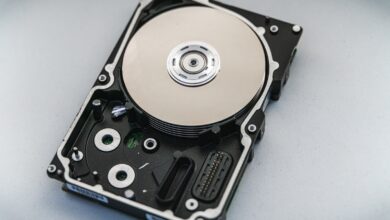
Storage type is second, and it’s non-negotiable rather than a preference. Any laptop still shipping with a traditional spinning hard drive in 2026 should be avoided outright, regardless of how attractive the rest of the spec sheet looks. The difference between an SSD and a hard drive isn’t a minor speed bump — it’s the difference between a laptop that boots in under fifteen seconds and one that takes over a minute, and between a system that feels responsive under everyday multitasking and one that stutters constantly. Even a smaller-capacity SSD (256GB, topped up with a cloud storage plan or external drive) beats a larger hard drive in every practical sense.
Battery life is third, and it’s the one most easily disguised by marketing. Manufacturers quote battery figures based on best-case, low-brightness, minimal-background-activity testing that has little relation to how anyone actually uses a laptop. When comparing budget models, look for independent reviews with real-world battery benchmarks rather than trusting the number on the box, and treat anything under seven or eight hours of quoted battery life with real scepticism, since actual use will likely bring that down further.
Chromebook, Windows or a budget MacBook Air
The operating system decision matters as much as any individual spec, and it’s where budget shoppers often make the wrong call simply because they compare price tags without comparing what each platform is actually good at.
Chromebooks remain the strongest value proposition for genuinely simple needs: web browsing, email, streaming, document editing through Google’s or Microsoft’s web apps, and light schoolwork. They’re inexpensive, have excellent battery life relative to their price, and are largely immune to the kind of slowdown-over-time that affects budget Windows machines, because ChromeOS is lightweight and updates cleanly in the background. The trade-off is real, though — Chromebooks struggle with software that needs to run natively rather than through a browser, offline-first professional tools, and some file management workflows that Windows and macOS users take for granted.
Windows remains the default choice for anyone who needs specific desktop software, whether that’s accounting programs, niche creative tools, or anything tied to a particular Windows-only application at work or study. Before buying a budget Windows laptop, it’s worth checking our Windows 11 compatibility guide, since some ultra-cheap models are still being sold with processors or TPM configurations that fall short of Microsoft’s requirements — a detail that matters more than it used to, given how firmly Windows 11 is now the only supported option going forward.
A budget MacBook Air deserves consideration too, and it’s easy to dismiss purely on sticker price without noticing that Apple’s entry-level Air, when it appears on sale or as a previous-generation model, competes directly with premium Windows ultrabooks rather than with true budget machines. Apple Silicon’s efficiency means even an older M-series MacBook Air will often out-battery-life and out-longevity a similarly priced Windows laptop, though you’re trading away touchscreens, a wider range of ports, and compatibility with some Windows-only software. Our comparison of Apple Silicon against Intel and AMD platforms goes into the performance-per-watt differences in more depth if you’re weighing this option seriously.
Student and family use cases
The right budget laptop changes considerably depending on who’s actually going to be using it, and buying for the wrong use case is the single most common budget-laptop mistake we see.
For students, particularly at high school or in the first year or two of university, a Chromebook or an entry-level Windows laptop with 16GB of RAM and a solid SSD covers the vast majority of coursework: research, essay writing, presentations, and video calls for group work. The exceptions are students in fields with specific software requirements — engineering, architecture, video editing, or anything involving CAD or heavy creative suites — where a more capable processor and dedicated graphics memory become genuinely necessary rather than nice-to-have.
For family shared-use laptops, durability and battery life tend to matter more than raw performance, since the machine will likely see a mix of homework, streaming, browsing and the occasional stress-test from more demanding software a family member wants to run. A slightly heavier, plastic-chassis laptop with a replaceable battery and a keyboard that can survive younger family members is often the better buy than a lighter, more premium-feeling model that’s more fragile under daily wear.
For anyone buying primarily for video calls and communication with family overseas, or for basic small-business admin, a Chromebook or low-end Windows laptop with a decent webcam and reliable Wi-Fi will comfortably do the job, and there’s little reason to spend more chasing performance that will never actually get used.
Buying smart at this price point
A few practical habits make the difference between a budget laptop that feels like a compromise and one that feels like a genuinely good deal.
- Compare like-for-like generations — a current-generation entry-level chip usually beats a two-generation-old mid-range chip at the same price
- Check independent battery and thermal benchmarks rather than trusting manufacturer claims
- Confirm RAM and storage before purchase, since both are frequently non-upgradeable on budget models
- Factor in the warranty and repair pathway, not just the sticker price
On that last point, it’s worth knowing that Australian shoppers have stronger protections than many realise. Under Australian Consumer Law, electronics come with automatic consumer guarantees covering acceptable quality and fitness for purpose, regardless of what a retailer’s return policy says or whether an extended warranty was offered at checkout. A laptop that fails well within a reasonable timeframe for its price and type may be covered by these guarantees even outside a standard warranty window, and no “no refunds” signage or disclaimer can override that right. For a second opinion on what to prioritise before you buy, CHOICE’s independent laptop buying guide is a genuinely useful, non-commercial second reference alongside anything we’ve covered here.
Final thoughts
The budget laptop market in 2026 rewards shoppers who know exactly which corners are safe to cut. Screen quality, chassis materials, speaker performance and port selection can all be compromised without much real-world impact. RAM, storage type and genuine battery life can’t be, because those three specs are what separate a laptop that still feels quick in three years from one that feels obsolete within one. Add a clear-eyed choice between Chromebook, Windows and a budget MacBook Air based on what you’ll actually use the machine for, rather than on price alone, and $1,200 goes a long way further than it used to. Buy on the specs that matter, ignore the ones that don’t, and keep your consumer rights in mind if anything goes wrong after the sale.